
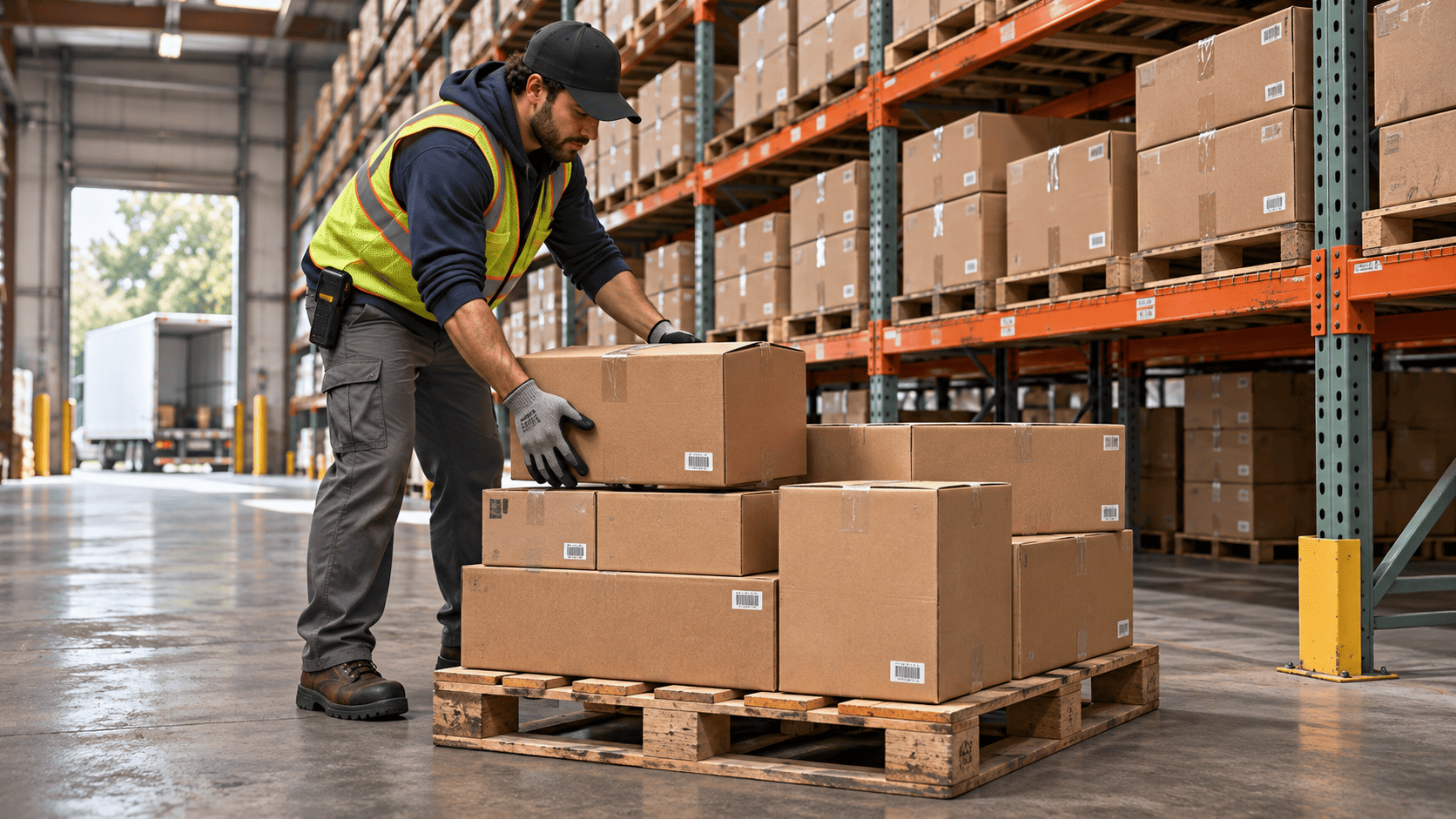
Case picking is a warehouse picking method in which workers or machines pull full, sealed cartons from storage to fill an order, instead of opening those cartons to select individual units. It’s the standard workflow for retail replenishment, wholesale, and any channel where customers buy in case-pack multiples. Piece picks fill parcels. Case picks fill pallets.
This guide covers how the process runs inside an order fulfillment operation, the main methods, where it’s used, and the trade-offs to plan for.
TL;DR
- Case picking moves full cartons, not units. Pickers move unopened cases, and order quantities are converted into case-pack multiples.
- Case picking is the middle tier between piece picking and pallet picking, built for store replenishment, wholesale, and marketplace inbound orders.
- Methods scale with volume: floor-level picking, high-level picking with lift trucks, batch and zone strategies, and automated systems.
- Savings carry trade-offs: heavier lifts, more pallet-position space, and strict pallet-build and labeling discipline.
- NovEx handles B2B case picking, pallet builds, and retailer compliance with 99.8% order accuracy.
Case Picking Meaning: What the Term Covers
The case picking meaning comes down to one variable: the pick unit. A worker retrieves a full carton (also called a case, master carton, or shipper) and places it on a pallet, cart, or conveyor. Nothing inside the carton is touched. Units stay sealed in the manufacturer’s packaging until they reach a store, a distributor, or a marketplace fulfillment center.
That’s why case-pack data matters so much. If a SKU ships 24 units per case and a retailer orders 240 units, the system releases a pick for 10 cases. If the same retailer orders 250, the extra 10 units become split-case work, which runs through a different workflow at a higher labor cost per unit.
💡 Tip: Before you start shipping, check that the number of units per case in your system matches what’s actually in each case. A wrong count can cause you to ship too few or too many units every time that SKU is ordered by the case.
Piece vs Case vs Pallet
Piece | Case | Pallet | |
|---|---|---|---|
Pick unit | Individual item | Full sealed carton | Full pallet of one SKU |
Typical order | DTC parcel, 1-5 units | Store or wholesale replenishment | Bulk B2B transfer |
Common equipment | Carts, totes, handheld scanners | Pallet jacks, order pickers, conveyors | Forklifts |
Labor per unit | Highest | Moderate | Lowest |
How the Case Pick Process Works
In a case picking warehouse, the process usually runs in five steps:
- Release. The warehouse management system (WMS) uses the number of units per case to work out how many full cases to pick for each product. It flags any remaining units to be picked individually from a case. Accurate product records and consistent inventory management and control help your team pick the right quantities.
- Sequence. The WMS groups picks and routes them by location, typically putting the heaviest, most crush-resistant cases first so they land on the bottom of the pallet.
- Retrieve. Pickers pull cases from floor-level pick faces with a pallet jack, or from upper rack levels using lift equipment.
- Build. Pickers scan each case to confirm it matches the order, then stack the cases so the load stays stable. Once the pallet is complete, they secure the load with stretch wrap.
- Ship. The finished pallet gets a logistics label carrying a Serial Shipping Container Code (SSCC), the one data element GS1 makes mandatory on a label, then ships less-than-truckload (LTL) or full truckload (FTL) with an advance ship notice (ASN).
Case Picking Methods
The right mix of case picking methods depends on order profile, SKU count, building height, and volume. Most facilities run two or more side by side.
Low-Level Manual Picking
Pickers ride an electric pallet jack through floor-level slots and build the pallet as they travel, a setup known as pick-to-pallet. It’s a common approach for fast-moving SKUs because it needs little capital beyond racking and jacks. Picking two pallets in one trip, one per order, raises pick density and cuts travel time per case.
High-Level Picking With Lift Equipment
Slower movers often sit on upper rack levels, where operators use order pickers or reach trucks to retrieve them. This frees prime floor slots for fast movers, but it adds training and certification requirements.
Batch and Zone Strategies
Batching groups store orders that share SKUs into one pick run, then sorts cases to individual order pallets at a consolidation point. Zone picking assigns pickers to fixed aisles and passes partial orders between zones on a conveyor. Both follow the same logic as the picking and packing methods used for each, applied to cartons.
Automated Systems
Automated case picking replaces some or all manual travel with conveyors, autonomous mobile robots that move pallets between zones, shuttle storage, and robotic mixed-case palletizers that stack cartons by size, weight, and crush strength.
Investment appetite is rising: in the 2026 MHI Annual Industry Report, 56% of supply chain leaders said they were increasing technology and innovation spending. Most operations automate transport and sortation first and keep people at the pick face.
Where Case Picking Is Commonly Used
Case-level picking is most common in distribution centers, one of several warehouse types designed around throughput rather than long-term storage. Typical applications include:
- Retail store replenishment: Big-box and grocery distribution centers order by the case and enforce routing guides for labels, pallet configuration, and delivery appointments. Missed requirements become chargebacks, which is why B2B order fulfillment depends on case-level accuracy.
- Wholesale and distributor orders: Distributors buy in carton multiples and break cases further downstream.
- Marketplace inbound shipments: Brands restocking marketplace fulfillment centers send sealed, case-labeled cartons rather than loose units.
- Food, beverage, and supplements: Cases are picked by lot and expiration date under FIFO or FEFO rules, so rotation matters as much as speed.
- Omnichannel brands: Many brands serve parcel and wholesale demand from one inventory pool. Omnichannel fulfillment means running case and piece workflows in one building.
Benefits and Trade-Offs
Order picking is usually the most expensive activity in a warehouse. A 2023 review of order-picking research puts it at more than 55% of total warehouse cost. Moving a full carton in one pick means fewer touches per unit, which is where most of the labor savings come from. Sealed cartons also arrive pre-counted, so quantity errors drop, and uniform carton sizes produce denser, more stable pallets.
The trade-offs:
- Ergonomic load: Repeatedly lifting heavy cases can strain workers. In 2024, U.S. transportation and warehousing employers reported 4.2 nonfatal workplace injuries per 100 full-time equivalent workers, nearly double the private-sector rate of 2.2.
- Space: Fast movers need full-pallet pick positions, which consume more floor area than shelving for eaches.
- Case-pack mismatch: Orders that don’t divide evenly into case packs create split-case labor.
- Pallet-build quality: Heavy cartons can crush lighter ones stacked underneath, and a single mislabeled carton can lead to a retailer chargeback.
* Split-case work, also called broken-case or break-pack picking, opens a carton and selects individual units from it. Most B2B operations need both, so slot split-case inventory separately from full-case reserve.
Run B2B Case and Pallet Orders With a High-Touch 3PL
At NovEx, case picking is part of the value-added warehousing services we run for B2B and omnichannel brands from bicoastal fulfillment centers in Salt Lake City and Memphis. Our custom WMS gives you real-time visibility and lot control, and our team handles GS1-128/SSCC labeling, EDI and ASN processing, and routing-guide-compliant palletized freight via LTL and FTL, at 99.8% order accuracy.
Our job is to make yours easier. You set the retailer requirements; we handle the labels, pallet builds, and paperwork. Request a quote.
FAQs
What is case picking in warehouse operations?
It’s an order fulfillment method where workers pull full, sealed cartons from storage and build them onto pallets or carts for shipment. The carton is the pick unit, so the units inside are never handled individually before delivery.
What does a typical case pick order look like?
A supplements brand sells protein bars in 12-count cases. A grocery chain orders 60 cases for its regional distribution center, so a picker pulls 60 sealed cartons, builds a pallet, applies an SSCC label, and ships LTL.
How is a case pick different from a pallet pick?
A pallet pick moves an entire single-SKU pallet as it was received, usually by forklift. A case pick builds a new pallet from individual cartons, often mixing several SKUs to match a store or wholesale order.
When does automated case picking make sense?
Automation pays off when case volumes are high and steady, packaging is uniform, and labor is hard to staff. Facilities with seasonal swings or irregular carton sizes often start with conveyors and keep manual picking at the pick face.