
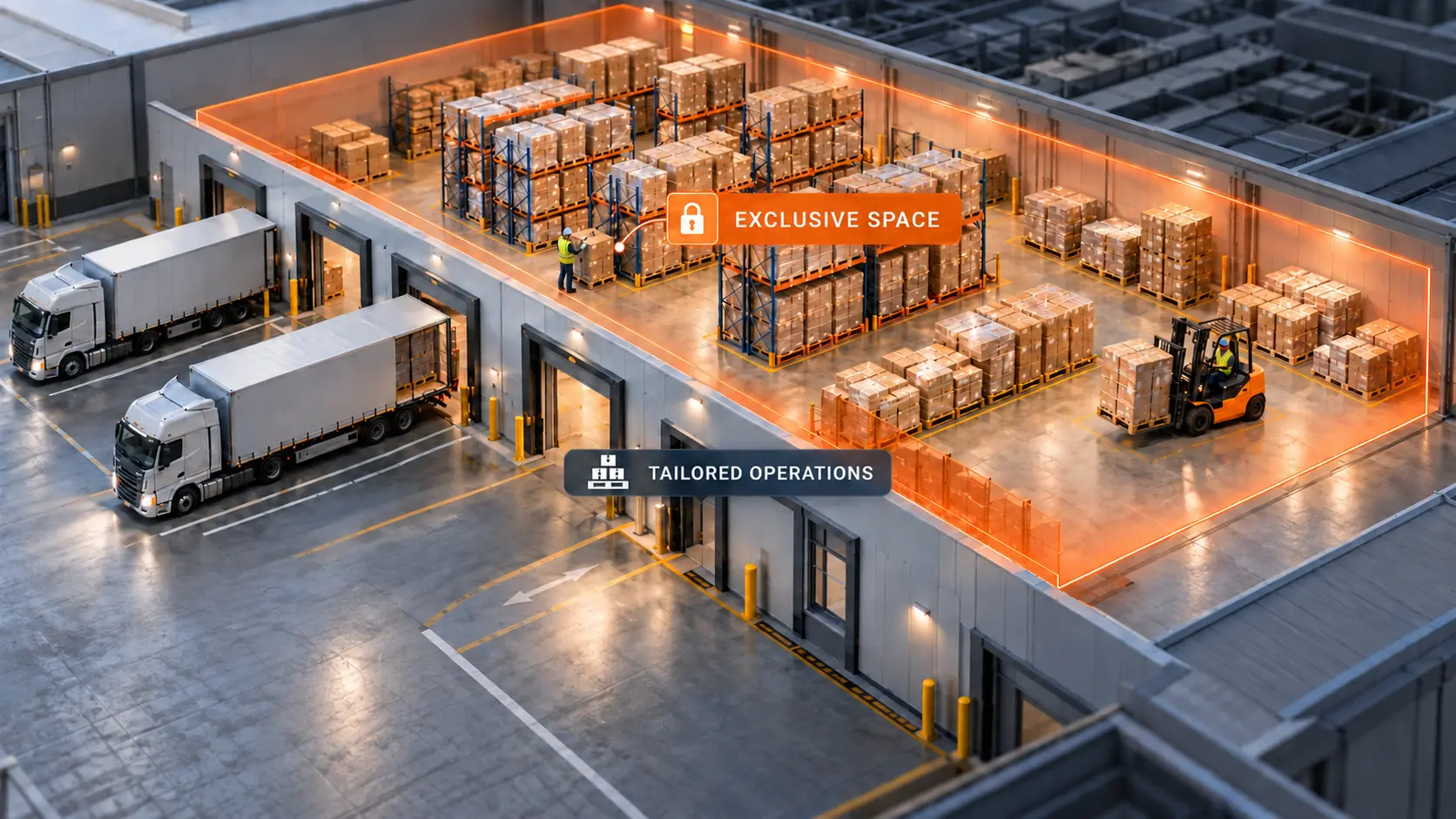
Dedicated warehousing is a model where one company contracts exclusive use of warehouse space, labor, and systems instead of sharing them with other clients. The space is configured around your SKUs, the team is trained on your products, and the capacity is yours whether you fill it in March or in November. That exclusivity is the entire value proposition, but it is also the entire cost struggle.
This guide covers what the model means, how a contract is structured, where it beats shared space, and the volume threshold where the math starts working in your favor.
TL;DR
- Dedicated warehousing is exclusive, not just private. One client controls the space, the labor team, the racking layout, and the workflows inside a defined footprint.
- Costs behave differently. Shared warehousing is mostly variable cost per unit; a dedicated warehouse converts that into a largely fixed monthly cost.
- The breakeven is volume. Below roughly 750-800 orders per day, most brands pay a premium for exclusivity they cannot fill.
- Contracts run long. Three to seven years is standard, because the provider commits real estate and headcount to one account.
- Specialized handling shifts the math early. Hazmat, cold chain, lot traceability, and retail compliance often justify a dedicated 3PL well before pure volume does.
What Is Dedicated Warehousing?
Dedicated warehousing is a contracted arrangement in which a third-party logistics provider assigns a defined facility to a single client, along with the staff, equipment, and system configuration to run it. No other account stores inventory in that footprint, competes for its dock doors, or pulls from its labor pool. Some also call it contract warehousing.
In a multi-client building, your pallets sit alongside four other brands, and your orders are picked by whoever is on the floor during that shift. In a dedicated footprint, the racking pitch, pick path, packing station layout, and standard operating procedures are built for your order profile, not anyone else’s.
➡️ If another client’s peak season can push your orders down the queue, we’re not talking about a dedicated space.
How Dedicated Warehousing Works
The arrangement is built before a single pallet arrives. A typical setup runs through five stages.
- Volume and profile modeling. You supply order history, SKU count, unit dimensions, seasonality curves, and channel mix. The provider translates that into square footage, pallet positions, pick faces, and headcount.
- Contract term. Terms usually land between three and seven years, because the provider is signing a lease and hiring a permanent team against your forecast.
- Pricing structure. Most agreements use cost-plus, fixed-plus-variable, or a hybrid. The fixed component covers space and base labor; the variable component covers overtime, peak surge, and value-added work.
- Build-out and integration. Racking is installed to your pallet profile, the WMS is configured to your SOPs, and API connections are built to your OMS, ERP, or cart platform.
- Governance and review. Quarterly reviews reset labor plans, space allocation, and pricing against actual volume rather than the original forecast.
Dedicated vs. Shared Warehousing
The arrangement is built before a single pallet arrives. A typical setup runs through five stages.
Factor | Dedicated warehousing | Shared warehousing |
|---|---|---|
Cost behavior | Largely fixed monthly | Variable per unit or order |
Typical contract | 3-7 years | 1-3 years |
Customization | Racking, SOPs, packaging, systems | Limited to provider standards |
Capacity at peak | Guaranteed; you hold the footprint | Competes with other clients |
Cost in a slow quarter | Paid in full regardless of volume | Falls with volume |
Best fit | Steady, high, or specialized volume | Seasonal or unpredictable volume |
➡️Shared space converts fixed cost into variable cost, which is exactly what a brand with a 4x Q4 spike wants.
➡️Dedicated space does the reverse, which is what a brand with flat weekly volume and tight compliance requirements wants.
✍🏻 If you are still weighing models, our breakdown of warehouse types maps the full range.
5 Benefits of a Dedicated Warehouse
1. Operational control end to end
With a dedicated operation, you can tailor daily workflows to your products and customers. You decide how orders are picked, how often quality checks happen, how packages are prepared, and when orders must ship. Adjustments can be discussed directly with the team running your operation.
2. A team that knows your products
Continuity is the underrated benefit. Dedicated labor learns your fragile SKUs, your retailer routing guides, and your packaging standards, which is what pulls order accuracy above 99% and keeps it there. With average hourly earnings in warehousing and storage at $26.74, retaining a trained crew is also cheaper than re-staffing one every peak season.
3. Guaranteed capacity
Multi-client buildings tighten when everyone peaks at once. With U.S. industrial vacancy at 6.5% in Q2 2026, securing extra warehouse space during a rush can be difficult. A dedicated footprint gives you the space you need year-round, including peak season.
4. Compliance you can configure
Regulated categories need the building built around the rule. Dedicated fulfillment lets you configure segregated storage, controlled access, and lot-level traceability to meet current good manufacturing practice requirements, and to run safety programs against OSHA’s warehousing standards with one trained crew rather than a rotating pool.
5. Predictable budgeting
A fixed monthly cost is easier to model than a variable rate, particularly when the producer price index for warehousing and storage keeps moving.
When a Dedicated 3PL Makes Sense
Compare costs at an order volume you can sustain. Suppose shared warehousing costs $3 per order, while dedicated space and staffing for the same work cost $24,000 a month. At 400 orders a day for 22 working days, shared costs $26,400, making dedicated $2,400 cheaper. At 200 orders a day, shared costs $13,200, making dedicated $10,800 more expensive.
These figures are illustrative. Steady volume makes dedicated space easier to justify; specialized handling can strengthen the case. If demand swings sharply, shared or hybrid space may fit better. Use our 3PL selection guide to better assess your options.
What to Check Before You Sign A Dedicated 3PL Contract
- Labor model: is headcount named and dedicated, or drawn from a shared pool at peak?
- Escalators: how do rent, wage, and fuel adjustments work, and are they capped?
- Exit and flex terms: what happens if volume drops 30% in year two?
- Systems ownership: who owns the WMS configuration and the integrations if you leave?
- Performance standards: are dock-to-stock, order accuracy, and on-time ship rates contractual or aspirational?
Build a Dedicated Fulfillment Model That Matches Your Volume
Plenty of brands run a dedicated core for steady B2B and retail volume and lean on shared capacity for seasonal DTC spikes.
At NovEx, we tailor warehousing and fulfillment to your order volume and handling needs. Steady volume may call for dedicated space and a named team. Kitting and labeling may call for value-added warehousing. From Salt Lake City and Memphis, we can reach over 90% of the U.S. by two-day ground shipping. You get a team that knows your operation, backed by founder-led accountability. Request a quote.
Frequently Asked Questions
Is dedicated warehousing the same as contract warehousing?
Largely yes. Both describe exclusive, contracted use of space, labor, and systems for a single client over a multi-year term. Contract warehousing emphasizes the agreement structure, while dedicated emphasizes the exclusivity of the resources themselves.
How much volume do you need for a dedicated warehouse?
There is no universal floor, but most brands need consistent daily order volume or full-pallet throughput that keeps a fixed team busy across a full week. Below that, shared or multi-client space is usually cheaper per unit.
Can a dedicated 3PL handle seasonal spikes?
Yes, but the contract has to allow it. Surge labor, temporary racking, and overflow space are negotiated terms, not automatic inclusions. Brands with sharp seasonality often pair a dedicated core with flexible overflow capacity.
What is an example of a brand that should not go dedicated?
A seasonal apparel brand shipping 2,000 orders a day in Q4 but 300 a day in spring. Its annual average sits far below any dedicated break-even, so it would fund idle labor and racking for eight months to cover four.
How does dedicated warehousing affect inventory accuracy?
A consistent team working a fixed layout with configured cycle-count rules typically outperforms rotating labor. Tight inventory management and control also reduce aged stock because counts and rotation rules run on a set cadence.