
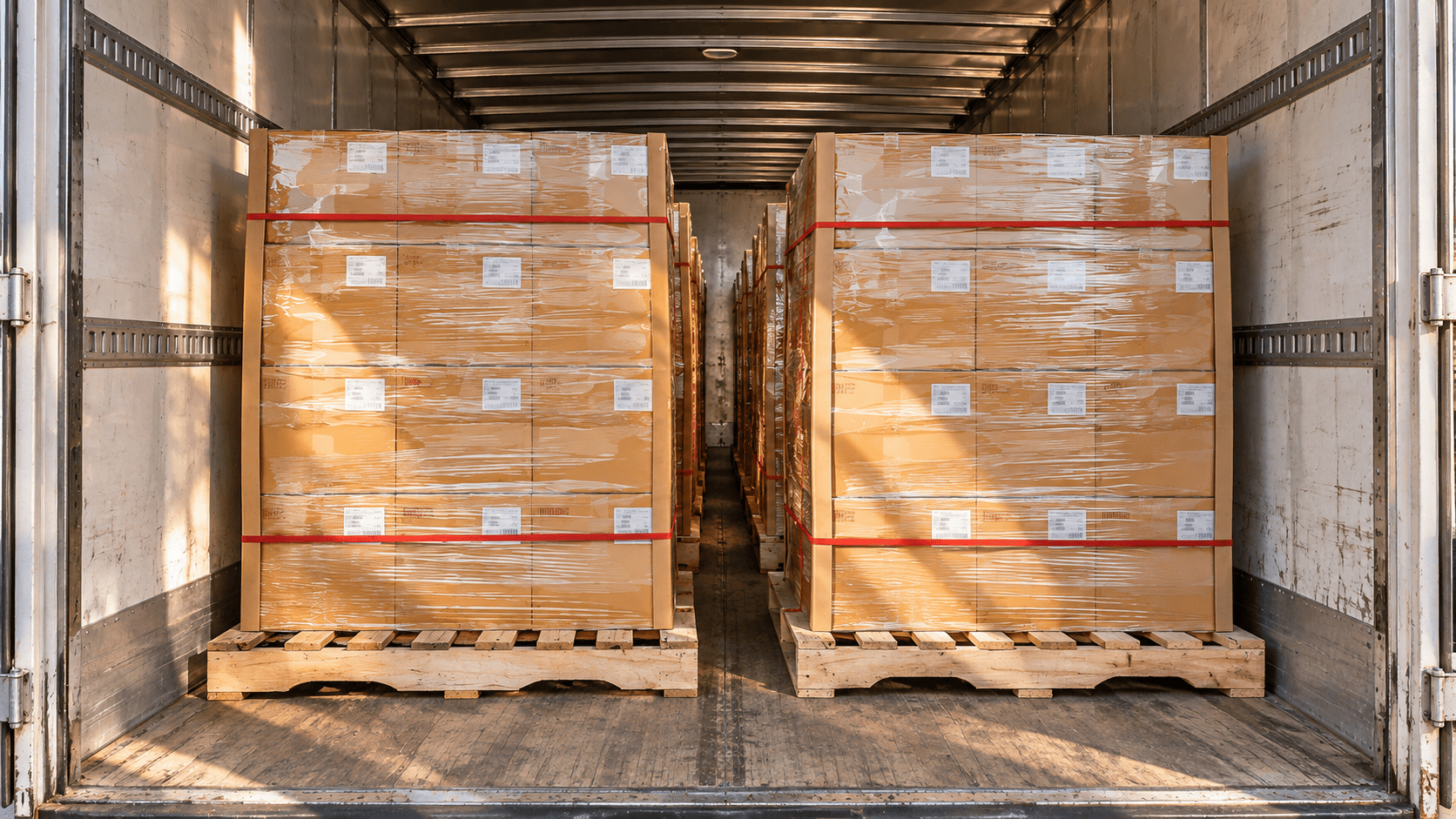
Pallet In, Pallet Out (PIPO) is a warehousing model where inventory arrives on pallets, sits in storage as pallets, and ships as pallets, without ever being broken down into cases or units. For brands moving high volumes of a narrow SKU range to retail distribution centers, distributors, and manufacturers, it is the lowest-touch way to run inventory through a 3PL. Most warehouses count eaches. This model counts pallets.
Let’s discuss how the process runs inside a 3PL, how it’s billed, and where it stops making sense.
TL;DR
- Pallet is the only handling unit. The pallet stays the unit of work from receiving to loading, so labor is spent per pallet, not per case or per item.
- PIPO is the best for B2B volume: retail DC replenishment, wholesale, and manufacturing inputs with few SKUs.
- Billed per pallet: receiving, monthly storage, outbound handling, plus accessorials for rework.
- PIPO paired with pick and pack. Most brands run both models rather than choosing one.
- NovEx stores and ships B2B pallets, handles retail compliance, and maintains 99.8% overall order accuracy.
What Pallet In, Pallet Out Means in a 3PL Warehouse
In pallet-in, pallet-out warehousing, the pallet itself is the unit of measure. A third-party logistics (3PL) provider receives it, records it under one license plate number (LPN) in the warehouse management system (WMS), stores it in a rack or floor position, and ships it intact when an order calls for it. Nobody opens a carton.
That separates the model from the two other common picking methods. Case picking pulls full cartons from a pallet to build mixed orders, and item picking pulls individual units for parcel orders. Every step down that ladder adds touches, labor, and chances for error.
It also differs from cross-docking, which moves pallets from inbound to outbound trucks with little or no storage.
➡️ Cross-docking sits on the distribution side of logistics operations.
➡️ PIPO holds inventory for days or months, then releases it against orders.
How the PIPO Process Works, Step by Step
- Advance notice. An EDI 856 ship notice tells the warehouse how many pallets are coming and which SKUs and lots they hold, so the dock appointment and storage locations are planned before the truck arrives.
- Receiving. Associates verify pallet count against the ASN, inspect for damaged loads or broken pallets, photograph exceptions, and apply a pallet ID. Many retailers require a GS1 Serial Shipping Container Code (SSCC) so each pallet is tracked as one logistic unit.
- Putaway. The WMS assigns each pallet a location based on dimensions, weight, and velocity. Lot numbers and expiration dates are captured here, which makes lot control and FIFO or FEFO rotation possible later.
- Allocation. The warehouse system reserves whole pallets for each purchase order based on arrival or expiration dates. The team pulls them intact.
- Loading. Forklift operators, working under OSHA’s powered industrial truck standards, stage pallets at the dock. The team confirms wrap and labels, builds the bill of lading, loads the trailer, and sends an outbound ASN. Typical LTL range is one to six pallets, with larger counts moving as volume LTL or full truckload.
📌 Note: “Pallet out” does not always mean untouched. If the customer requires a different label, pallet height, or pallet type, the pallet is reworked before it ships, usually billed as an accessorial.
How 3PLs Bill PIPO
Because the pallet is the unit of work, it is also the unit of billing. That matters as costs climb: the State of Logistics report put U.S. business logistics costs at $2.58 trillion for 2024, with warehousing costs growing an average of 4.6% a year over five years.
Charge | Typically billed | What moves the rate |
|---|---|---|
Receiving | Per pallet | Inspection depth, labeling, palletized vs. floor-loaded freight |
Storage | Per pallet, per month | Pallet height, weight, and oversized footprint |
Outbound handling | Per pallet | Staging, wrapping, documentation, loading |
Accessorials | Per pallet or per hour | Relabeling, restacking, pallet exchange, compliance labels |
PIPO Cost Calculation And Example
Formula:
➡️ Cost per case handled = (receiving + storage + outbound charges) ÷ cases shipped
Example:
Take 40 pallets of canned beverages at 60 cases per pallet, stored for one month. At illustrative rates of $12 to receive, $18 to store, and $12 to ship each pallet, the bill is $1,680, or $0.70 per case handled.
When the Model Fits, and When It Doesn't
Where Pallet In, Pallet Out Works
The model is standard in many distribution-focused types of warehouses, and it fits best when:
- Customers order full pallets: retail DCs, distributors, wholesale accounts, manufacturing lines
- SKU count is low, and volume per SKU is high
- Packaging is standardized from shipment to shipment
- Inventory turns quickly, so pallet positions don’t sit idle
Food and beverage, consumer packaged goods, building materials, and industrial components are the classic examples.
Where Pallet In, Pallet Out Breaks Down
Small, mixed orders force pallets to be broken, which turns the flow into case and unit picking. Slow movers create a second problem: a pallet that ships in nine months pays nine months of pallet storage, which is why aging inventory reports belong in any inventory management review.
In practice, most brands run both models from the same inventory. Full pallets go to retail and wholesale accounts, while a share of the stock is broken down for D2C orders.
Inbound Standards That Keep the Flow Efficient
Speed matters, but consistency matters more. Pallet-level handling is only as efficient as the pallets suppliers send, so write these into your inbound requirements:
- Standard 48 x 40-inch pallets in good repair
- One SKU, and ideally one lot, per pallet
- An agreed maximum height and weight that fits rack positions
- Stretch wrap and corner boards on tall or unstable loads
- A pallet label with SKU, lot, and quantity, or an SSCC
- An ASN sent before the truck leaves the supplier
💡 Mixed-SKU pallets break the model at the door. If a supplier can’t avoid them, agree on a rework rate up front so sorting is billed predictably, not disputed later.
Run Your Pallet Flow With a 3PL Built for B2B Volume
At NovEx, pallet work is a core part of our B2B fulfillment operation. We support pallet storage and racking across our Memphis and Salt Lake City warehousing and fulfillment centers.
We manage FTL, LTL, and palletized freight, and handle pallet configuration, ASNs, and routing guide compliance. Cross-docking and rework run through the same team, with 99.8% order accuracy across the operation.
Besides moving pallets, we can help you move your business forward. Request a quote.
FAQs
What does PIPO mean in logistics?
PIPO stands for pallet in, pallet out. Inventory is received, stored, and shipped as whole pallets, without breaking them into cases or units. It keeps handling, labor, and damage risks low for high-volume B2B shipments.
What is an example of pallet in, pallet out?
A flooring manufacturer ships truckloads of palletized tile into a 3PL. The warehouse stores the pallets by lot, then ships four- to six-pallet orders to regional distributors by LTL, without opening a single carton.
Is pallet in, pallet out cheaper than case picking?
Per unit shipped, usually yes. PIPO is billed per pallet, while case picking adds labor for every carton pulled. The savings disappear when customers order mixed or partial pallets, because the warehouse must break pallets anyway.
Can a 3PL run PIPO and pick and pack together?
Yes. Many brands ship full pallets to retail and wholesale accounts while the same 3PL breaks a share of that inventory for case or e-commerce orders. A single WMS keeps both flows functional from one accurate inventory count.